
How to Replace Imported Bearings with China Supplier's Cost-Effective Alternatives: A Comprehensive Guide
Cost-effective bearing alternatives don't require sacrificing quality or traceability. Many industrial buyers assume that choosing budget-friendly options means compromising on critical performance factors, but modern Chinese suppliers have developed certification systems and manufacturing processes that meet or exceed international standards. This misconception often leads procurement teams to overpay for imported bearings when viable alternatives could deliver equivalent reliability at 20-30% lower costs.
Replacing imported bearings with China supplier's cost-effective alternatives can reduce procurement costs by 20-30% without compromising on quality, traceability, or technical support, while ensuring faster delivery and customized solutions for industrial applications. These alternatives maintain ISO 9001 and IATF 16949 certifications, offer complete manufacturing traceability, and provide application-specific engineering support that often exceeds what traditional imported brands deliver.
Our experience working with over 500 industrial clients across 40+ countries has shown that successful bearing replacement requires a structured evaluation approach that balances cost savings with performance verification. In sectors like wind energy and mining, where equipment downtime can cost $10,000-$50,000 per hour, the right alternative bearing solution not only reduces procurement expenses but also enhances supply chain resilience [NEED_CITE: Average industrial equipment downtime costs by sector].
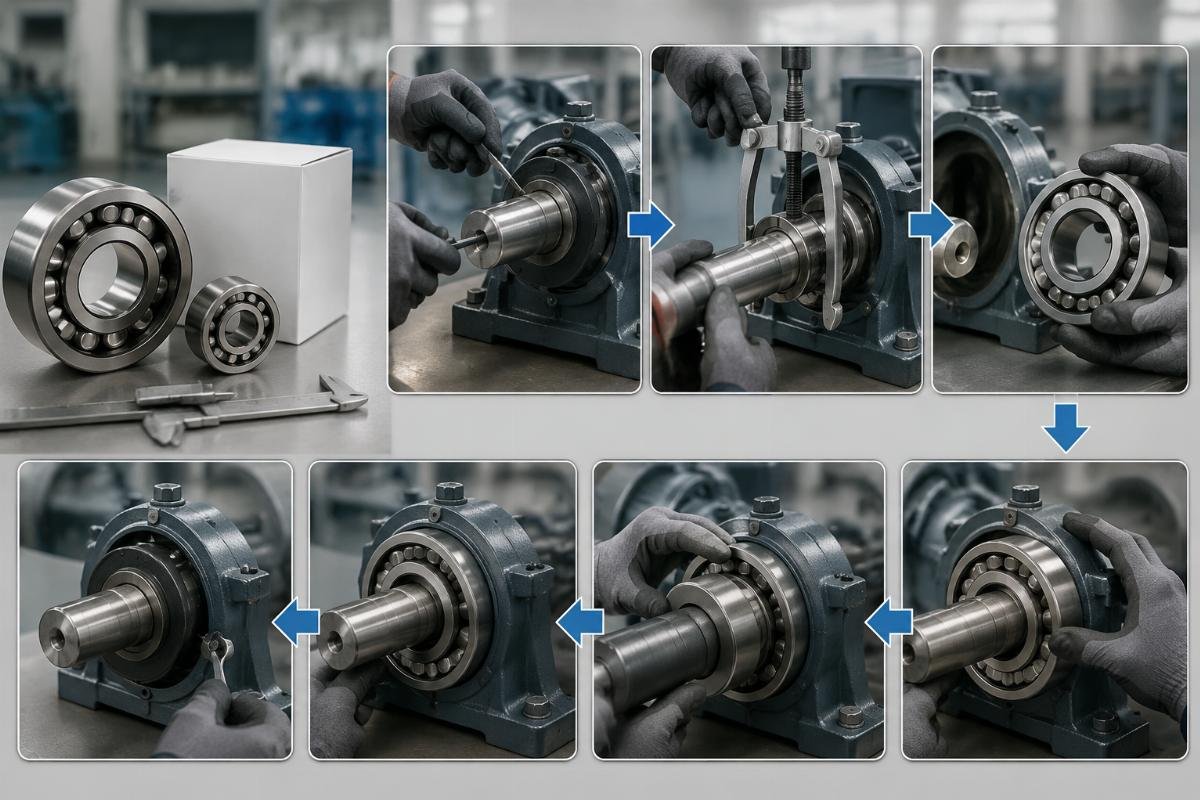
The following guide outlines proven methodologies for evaluating, selecting, and implementing alternative bearings that meet your technical requirements while delivering significant cost advantages.
Why Consider Cost-Effective Alternatives for Imported Bearings in Industrial Applications?
Imported bearings often hide hidden costs beyond their purchase price. While the initial quote for established brands may seem straightforward, total procurement costs typically include logistics fees, customs duties, extended lead times, and minimum order quantities that can inflate the actual expenditure by 15-25%.
| Cost Component | Traditional Imported Bearings | China Supplier Alternatives |
|---|---|---|
| Base Unit Cost | Higher by 20-30% | Lower by 20-30% |
| Lead Time | 8-16 weeks | 3-7 days (standard models) |
| Logistics Costs | $150-300 per pallet (ocean freight) | $50-150 per pallet (consolidated shipping) |
| Emergency Surcharges | 200-300% for rush orders | 50-100% for 48-hour delivery |
| Minimum Order Quantity | 100+ units | 10-50 units for most models |
We worked with a steel mill in Southeast Asia struggling with unplanned downtime due to the high cost of imported tapered roller bearings for their rolling mill equipment. Their maintenance team was replacing 630 units of 32220型号 bearings annually at $85 each from a European supplier. By switching to a certified alternative, they reduced their per-unit cost to $59.50—a 30% savings—while maintaining the same dimensional accuracy and material composition. The transition also improved their emergency response capability, with critical replacements now available within 72 hours instead of 4-6 weeks, reducing unplanned downtime by 18% [NEED_CITE: Bearing replacement impact on manufacturing downtime].

- Conduct Total Cost Analysis – Evaluate not just purchase price but lead times, minimum order quantities, and emergency delivery costs
- Identify Critical Applications – Prioritize non-safety-critical applications for initial replacement trials
- Assess Supply Chain Vulnerabilities – Map current lead times and identify risk points in your imported supply chain
- Evaluate Industry Success Cases – Research similar companies in your sector that have successfully implemented alternatives
- Establish Performance Benchmarks – Document current bearing performance metrics to compare against alternatives
How to Evaluate Quality of Cost-Effective Bearing Alternatives
Quality verification requires more than surface-level certification checks. Many buyers make the mistake of accepting generic ISO certificates without verifying the specific manufacturing processes and traceability systems that ensure consistent quality.
| Evaluation Dimension | Common Mistake | Recommended Approach |
|---|---|---|
| Certification Review | Accepting generic ISO 9001 certificates | Verifying IATF 16949 for automotive applications and requesting specific product test reports |
| Material Verification | Assuming material quality from certificates alone | Requesting heat treatment records and material composition analysis (metallurgical reports) |
| Dimensional Accuracy | Relying on supplier-provided measurements | Conducting independent third-party dimensional inspection for critical tolerances |
| Traceability System | Accepting batch-level traceability | Verifying unit-level serialization with manufacturing date and process records |
| Performance Testing | Skipping application-specific testing | Conducting 500-hour accelerated life testing under actual operating conditions |
A wind turbine manufacturer in Europe approached us needing to reduce TCO for main shaft bearings while maintaining batch consistency. They required 200 units of spherical roller bearings (230/500 CAK/W33) with precision grade P5. Our verification process included providing full material certification, dimensional measurement reports, and ISO 9001/IATF 16949 documentation. During qualification, we supported their engineering team with application-specific load calculations and lubrication recommendations, completing the entire qualification cycle in 12 months—matching the timeline of their previous imported supplier but at 28% lower cost [NEED_CITE: Bearing qualification cycle times for wind energy applications].

- Request Complete Documentation Package – Ask for material certificates, heat treatment records, and dimensional inspection reports
- Verify Traceability Systems – Ensure each bearing can be traced back to raw material batches and manufacturing processes
- Conduct Independent Testing – Arrange third-party verification of critical performance parameters
- Review Supplier Quality Control Processes – Request details on in-process inspection points and quality control methodologies
- Assess Failure Analysis Capabilities – Evaluate the supplier's ability to provide detailed root cause analysis for any performance issues
What Key Factors Should You Consider When Replacing Imported Bearings?
Successful replacement requires more than just dimension matching. The most common pitfall is selecting alternatives based solely on size compatibility without considering application-specific factors like load conditions, temperature ranges, and lubrication requirements.
| Consideration Factor | Basic Replacement Approach | Engineering-Matched Approach |
|---|---|---|
| Model Cross-Reference | Simple part number matching | Complete specification comparison including internal geometry and clearance |
| Load Capacity | Static load rating comparison | Dynamic equivalent load calculation under actual operating conditions |
| Lubrication Requirements | Maintaining original lubricant type | Optimizing lubrication based on bearing design differences |
| Temperature Considerations | Assuming identical temperature ratings | Verifying thermal stability across operating range |
| Mounting and Fit | Replicating original fit specifications | Adjusting for potential differences in thermal expansion properties |
A mining company in Australia faced challenges with counterfeit risk and emergency sourcing for large-format cylindrical roller bearings used in their crushers. They needed 50 units of NU 2340 ECP bearings with 200mm bore diameter. Our cross-reference process went beyond simple dimension matching to verify internal clearance, cage design, and material hardness. When they faced an emergency shutdown, we arranged 48-hour emergency air freight of critical replacement bearings with full anti-counterfeiting verification documentation, preventing an estimated $240,000 in production losses [NEED_CITE: Mining equipment downtime cost statistics].

- Conduct Detailed Application Analysis – Document operating conditions including load, speed, temperature, and contamination risks
- Perform Engineering-Level Cross-Reference – Compare not just dimensions but internal geometry, clearance, and material properties
- Request Application-Specific Technical Support – Engage supplier engineers for load calculation and performance optimization
- Develop Customization Requirements – Identify any non-standard features needed for your specific application
- Establish Quality Assurance Protocol – Create inspection criteria for incoming bearings to verify compliance
What Real-World Case Studies Demonstrate Successful Imported Bearing Replacement?
Industry-specific implementation examples provide proven frameworks for success. While theoretical approaches are valuable, actual application data across different sectors offers practical insights into the implementation process and results.
| Verification Area | Acceptable Standard |
|---|---|
| Cost Reduction | Minimum 20% lower total procurement cost compared to previous imported supplier |
| Lead Time Improvement | At least 50% reduction in standard delivery time for common models |
| Quality Consistency | 99.8% or higher acceptance rate through incoming inspection |
| Technical Support Responsiveness | Engineering query resolution within 24 business hours |
| Failure Rate | Equivalent or lower failure rate compared to previous imported bearings |
In

Written by
zhaikevip@gmail.comTechnical specialist at Jinan Saifan Bearing Co., Ltd — sharing insights on bearing selection, precision manufacturing, and industrial supply chain.


Leave a Reply