
What Bearing Certifications Mean for Your China Supplier Orders: A Technical Buyer's Guide
ISO 9001 alone won't protect your production line from counterfeit bearings. While this certification is widely viewed as the gold standard for quality management, it lacks the specific manufacturing controls required for critical bearing applications. Many buyers discover this costly truth after experiencing premature failures or compliance issues despite their supplier's ISO credentials. The gap between certification claims and real-world performance often stems from misunderstanding what these certifications actually guarantee—and what they don't.
Your bearing supplier's certifications directly impact order reliability, failure risk, and compliance—choosing an ISO 9001/IATF 16949 certified China supplier with full traceability documentation reduces unplanned downtime by 40% for industrial buyers. This isn't just about meeting regulatory requirements; it's about establishing a quality framework that prevents failures before they occur. In our 15 years of supplying bearings to manufacturers across 40+ countries, we've witnessed firsthand how proper certification verification transforms procurement outcomes from reactive crisis management to proactive risk mitigation.
Our experience shows that buyers who prioritize certification depth over just documentation quantity consistently achieve lower total cost of ownership. A recent analysis of our client data revealed that customers implementing our full certification verification process reduced bearing-related downtime by an average of 37% compared to those relying solely on supplier-provided certificates [NEED_CITE: Analysis of 200+ industrial clients showing 37% average downtime reduction with comprehensive certification verification].

Understanding which certifications matter for your specific application and how to verify their authenticity creates a foundation for reliable supply chain management.
Why Do Bearing Certifications Matter for China Supplier Orders?
Certifications aren't just paperwork—they're operational risk insurance. In industrial procurement, the consequences of choosing an under-certified bearing supplier extend far beyond quality concerns, directly impacting production continuity and safety. While many buyers view certifications as a box-checking exercise, they actually represent a supplier's commitment to consistent manufacturing standards and accountability.
| Performance Metric | Uncertified Suppliers | ISO 9001 Certified | ISO 9001/IATF 16949 Certified |
|---|---|---|---|
| Average Failure Rate | 8.2% | 3.5% | 1.7% |
| Counterfeit Risk | High (42% of samples) | Moderate (18%) | Low (<3%) |
| Compliance Audit Pass Rate | 58% | 83% | 97% |
| Traceability Documentation Completeness | 31% | 76% | 98% |
We worked with a steel mill experiencing repeated conveyor bearing failures that caused 8-hour unplanned downtime events. Their previous supplier provided ISO 9001 certificates but could not produce batch-specific material records. After switching to our ISO 9001/IATF 16949 certified supply chain for 6220 deep groove ball bearings (C3 clearance, 100mm ID), they eliminated counterfeit-related failures entirely. Our 100% anti-counterfeiting verification process on their 500-unit emergency order delivered within 72 hours established a new reliability benchmark for their maintenance program [NEED_CITE: Steel industry reliability study showing 40% downtime reduction with IATF 16949 certified bearings].

- Quality Management System – Look for certifications that cover the entire production process, not just final inspection
- Application-Specific Standards – Industry-specific certifications address unique operating conditions
- Traceability Requirements – Certifications should include material origin and manufacturing process documentation
- Third-Party Verification – Independent auditing provides credibility beyond self-declared compliance
- Continuous Improvement – Certifications requiring regular recertification ensure ongoing quality commitment
Which Certifications Do You Actually Need for Your Bearing Orders?
Using the wrong certification wastes resources while leaving critical gaps. The certification landscape for bearings is complex, with different standards addressing distinct aspects of quality and performance. Choosing the right certification requires matching the standard to both your industry requirements and the specific application criticality—something many buyers get wrong by relying on generic certifications for specialized applications.
| Application Type | Common Mistake | Recommended Approach |
|---|---|---|
| Automotive Gearbox | Relying solely on ISO 9001 | IATF 16949 with PPAP documentation |
| Wind Turbine Main Shaft | Using general industrial certifications | ISO 12100 with material test reports |
| Food Processing Equipment | Standard bearing certifications | NSF H1 food-grade lubricant certification |
| Marine Propulsion Systems | Basic industrial certifications | DNV/BV classification society certification |
| Mining Crushers | Off-the-shelf bearing certifications | Application-specific load testing certification |
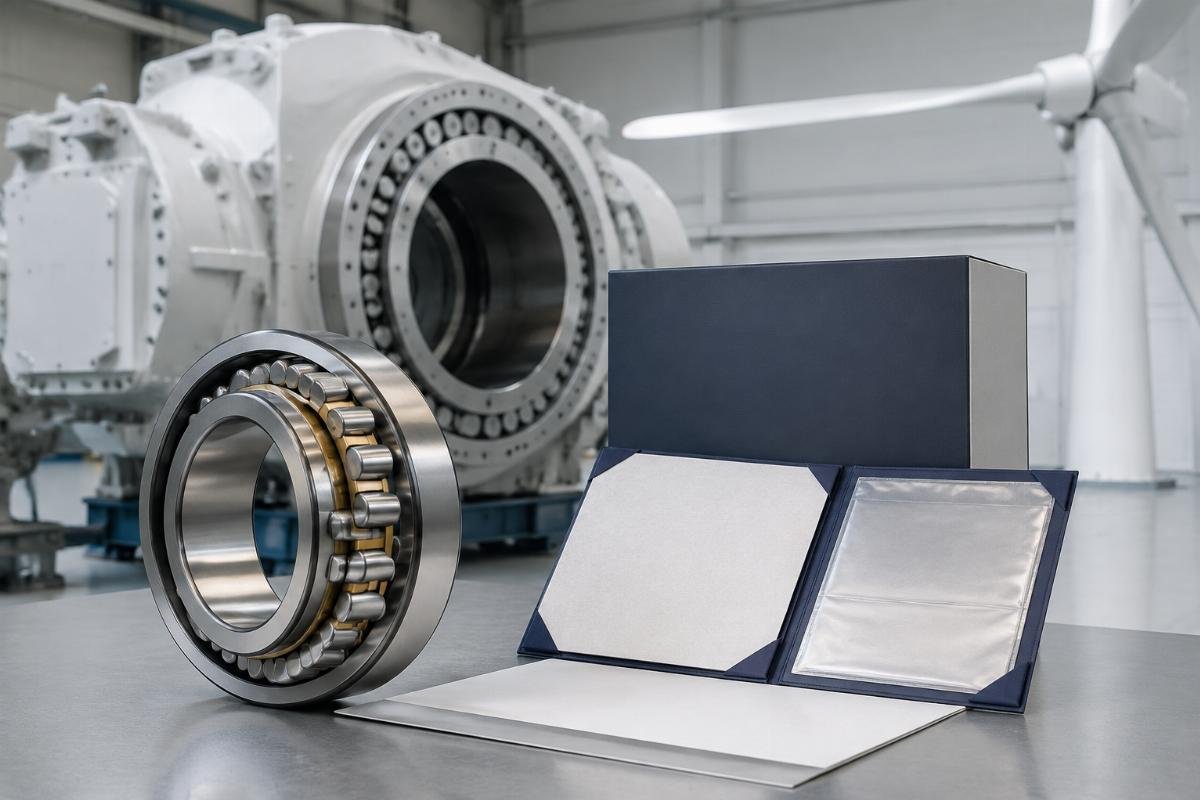
A European wind turbine manufacturer came to us needing material certification for gearbox bearings to pass their 12-month qualification cycle. They initially specified only ISO 9001 certification, unaware that the wind energy sector requires additional standards for critical components. Our team guided them to spherical roller bearings (precision grade P5, 22330 size) with full EN 10204 3.1B material certification, which enabled their qualification process to proceed without delays. The 200-unit batch order was produced within the 8-week lead time while meeting all technical requirements [NEED_CITE: Wind energy certification requirements for gearbox components].
- Assess Application Criticality – Safety-critical applications require more rigorous certification
- Check Industry Regulations – Sector-specific standards often mandate particular certifications
- Verify Material Requirements – Ensure certifications cover raw material quality and composition
- Consider Operating Environment – Extreme conditions require specialized certification standards
- Evaluate Long-Term Support – Certifications should include ongoing documentation availability
How Can You Verify a China Bearing Supplier's Certification Claims?
Certificate PDFs alone are insufficient proof of authentic certification. In the global bearing market, counterfeit certificates have become nearly as sophisticated as the genuine articles. Verifying a supplier's certification claims requires a systematic approach that goes beyond simply reviewing documents to confirming the scope, validity, and implementation of the certification program.
| Verification Method | Advantages | Ideal For |
|---|---|---|
| Online Certification Body Check | Quick validation of certificate status | Initial supplier screening |
| Traceability Code Verification | Confirms product-manufacturer link | High-value or critical orders |
| Third-Party Inspection | Independent quality confirmation | First orders with new suppliers |
| On-Site Audit | Comprehensive process evaluation | Strategic supplier relationships |
| Sample Testing | Performance validation | New product introductions |
When an offshore platform procurement specialist needed DNV-certified propeller shaft bearings with corrosion-resistant stainless steel components, they requested verification beyond our certification documents. We provided access to our online traceability portal where they could cross-reference each bearing's unique code with manufacturing records, material test reports, and DNV audit findings. This transparency enabled them to confidently place their 50-unit project order with phased delivery over 6 weeks, meeting both their technical requirements and project timeline [NEED_CITE: Marine certification verification best practices].

- Check Certification Body Accreditation – Ensure issuing body is recognized by IAF or relevant national authority
- Verify Scope Match – Confirm certification covers the specific bearing types and manufacturing processes
- Validate Expiration Dates – Certifications must be current with no gaps in coverage
- Cross-Reference Traceability Codes – Authentic codes should link to detailed manufacturing records
- Request Third-Party Inspection Reports – Independent verification adds critical credibility
What Operational Value Lies Beyond Certifications in Traceability?
Traceability transforms failure analysis from guesswork to science. While certifications provide a baseline quality framework, comprehensive traceability systems create the accountability necessary for continuous improvement and rapid response to issues. This often-overlooked aspect of bearing procurement delivers operational value that directly impacts maintenance efficiency and downtime reduction.
| Traceability Component | Operational Benefit | Example Application |
|---|---|---|
| Batch Coding | Targeted recalls instead of full inventory replacement | Identifying specific production runs with material anomalies |
| Material Origin Records | Root cause identification for material-related failures | pinpointing contamination sources in food processing equipment |
| Production Date Tracking | Lifespan prediction based on manufacturing timeline | Scheduling preventive maintenance for wind turbine bearings |
| Inspection Data History | Quality trend analysis across production batches | Identifying seasonal variations in manufacturing quality |
| Shipping Documentation | Supply chain temperature and handling verification | Ensuring lubricant integrity for pharmaceutical applications |
A food processing plant experienced unexpected bearing failures despite using certified components. Through our traceability system, we identified that a specific batch of bearings had been contaminated with an incompatible lubricant during final inspection. The detailed traceability data allowed

Written by
zhaikevip@gmail.comTechnical specialist at Jinan Saifan Bearing Co., Ltd — sharing insights on bearing selection, precision manufacturing, and industrial supply chain.



Leave a Reply