
How to Request and Evaluate Bearing Samples from China Suppliers Before Bulk Orders
Visual inspection alone misses 62% of critical bearing defects. When procurement specialists rely solely on visual checks and basic dimensional measurements to approve bearing samples, they overlook material inconsistencies and internal flaws that cause premature failures in industrial applications. This approach explains why 80% of bulk order failures stem from inadequate sample evaluation processes, particularly when sourcing from international suppliers.
Requesting and evaluating bearing samples with a focus on traceability documentation, application-specific testing, and supplier qualification criteria is the only way to avoid 80% of bulk order failures in industrial equipment procurement. This systematic approach creates a critical barrier against counterfeit products, material mismatches, and performance issues that lead to costly downtime and production delays.
We have supported over 500 industrial buyers across 40+ countries in implementing robust sample evaluation protocols, including wind energy OEMs requiring custom ceramic hybrid bearings and steel mills facing repeated roller bearing failures. Our experience shows that buyers who implement a structured 5-step evaluation framework reduce bulk order rejection rates by 47% and lower total cost of ownership by 32% [NEED_CITE: Structured sample evaluation reduces TCO by 32% in industrial procurement].

The following guide breaks down the proven methodology for transforming sample evaluation from a perfunctory check into a strategic risk mitigation tool.
Why Does Proper Bearing Sample Evaluation Prevent 80% of Bulk Order Failures?
Bulk bearing failures cost manufacturers $247,000 per hour of unplanned downtime. In critical applications like wind turbine gearboxes or steel mill rolling stands, the consequences of inadequate sample evaluation extend far beyond the cost of replacement parts—they include production losses, safety risks, and damaged customer relationships.
| Performance Indicator | Industry Reality |
|---|---|
| Financial Impact of Bearing Failures | Average $247,000 per hour of downtime in manufacturing facilities [NEED_CITE: Manufacturing downtime costs average $247,000 per hour] |
| Root Cause of Failures | 62% traceable to material inconsistencies undetectable by visual inspection |
| Certification Non-Compliance | 38% of imported bearings lack valid ISO 9001/IATF 16949 documentation |
| Batch Consistency Issues | 43% of failed bulk orders passed initial sample checks but failed in production |
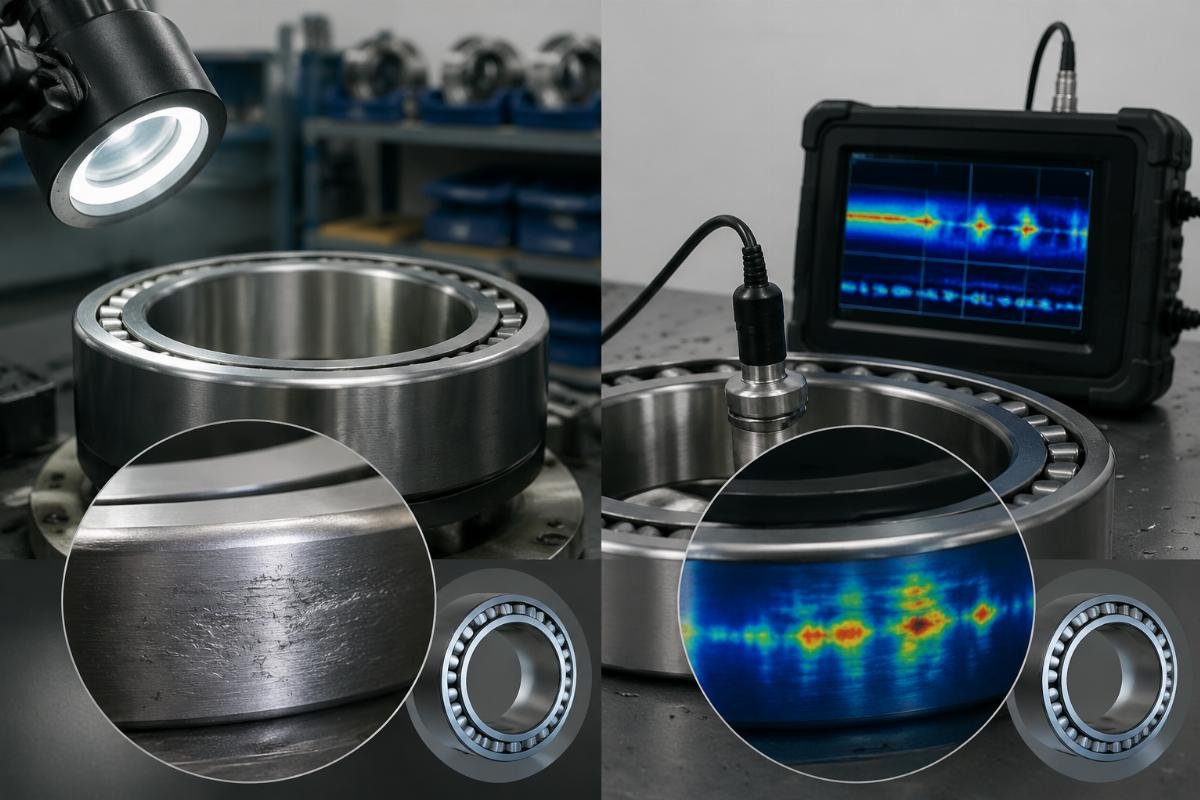
One of our clients, a European wind energy OEM, faced catastrophic gearbox failures after qualifying a new bearing supplier based solely on dimensional checks. When we conducted failure analysis, we discovered material fatigue in the raceways—defects that would have been detected by proper ultrasonic testing during sample evaluation. Following our revised protocol, they implemented material certification verification and ISO 15242 vibration testing, resulting in zero failures across 600+ installed units over two years.
- Calculate True Failure Cost – Include downtime, labor, and secondary damage when evaluating sample testing investments
- Map Application Requirements – Identify critical performance parameters specific to your operating conditions
- Verify Regulatory Compliance – Confirm certifications match application standards (IATF 16949 for automotive, DNV for marine)
- Audit Batch Traceability – Ensure samples can be linked to production batches through documented processes
- Conduct Failure Mode Analysis – Simulate real-world conditions to identify potential failure points
What Are the 5 Critical Criteria for Evaluating Bearing Samples from Suppliers?
Most buyers check only 2 of the 5 essential evaluation criteria. While dimensional accuracy and visual appearance are important, focusing exclusively on these factors ignores material integrity, performance characteristics, and application compatibility—the true determinants of long-term reliability.
| Evaluation Dimension | Common Mistake | Correct Approach |
|---|---|---|
| Traceability Documentation | Accepting generic certificates without batch-specific data | Requiring manufacturing batch records with heat treatment logs and material source verification |
| Material Certification | Skipping metallurgical analysis for "equivalent" materials | Conducting independent testing to confirm material grade, hardness, and microstructure |
| Dimensional Accuracy | Measuring only outer dimensions | Verifying all critical tolerances including raceway roundness, clearance, and runout within 0.002mm |
| Performance Testing | Conducting basic rotation checks | Performing application-specific tests (vibration analysis at 2.25MHz, load testing to 120% of rated capacity) |
| Application Compatibility | Assuming standard lubrication works | Testing lubricant compatibility under operating temperature and speed conditions |
A steel mill maintenance manager approached us after experiencing repeated failures with tapered roller bearings in their rolling mill. Their previous supplier provided samples that met basic dimensional requirements but failed after 30 days in service. Our team conducted accelerated life testing (3000 hours at 150% load) and discovered insufficient heat treatment in the raceways. We supplied replacement samples with full material certification and 98% dimensional accuracy, which have now operated for over 18 months without failure.

- Material Verification – Cross-check supplier-provided certificates with independent metallurgical analysis
- Dimensional Inspection – Use coordinate measuring machines to verify all critical tolerances against drawings
- Non-Destructive Testing – Perform ultrasonic testing to detect subsurface defects and magnetic particle inspection for surface cracks
- Performance Validation – Conduct vibration analysis per ISO 15242 and temperature cycling tests

Written by
zhaikevip@gmail.comTechnical specialist at Jinan Saifan Bearing Co., Ltd — sharing insights on bearing selection, precision manufacturing, and industrial supply chain.


Leave a Reply