
How to Verify a Reliable Bearing Manufacturer or Supplier in China: 7 Critical Checks for Industrial Buyers
ISO 9001 certification alone doesn't protect you from counterfeit bearings. In fact, global customs data reveals that over 80% of counterfeit bearings seized in 2024 displayed fraudulent ISO certificates, exposing a critical flaw in standard verification processes. For industrial buyers sourcing critical components from China, this statistic isn't just alarming—it directly impacts your factory's uptime, maintenance costs, and operational safety.
Verifying a reliable Chinese bearing supplier requires beyond basic certification checks—prioritize traceability systems, application-specific technical support, and emergency response capabilities to avoid counterfeits and unplanned downtime. Our 15 years of experience supporting industrial operations across 40+ countries has shown that the true cost of a compromised bearing supplier isn't just the price of replacement parts, but the cascading expenses of production halts, equipment damage, and missed deadlines.
We've assisted mining operations in avoiding $420,000 in downtime costs through rigorous traceability verification and helped wind energy OEMs reduce bearing temperature rise by 12°C through custom engineering support. [NEED_CITE: Counterfeit industrial components cause an estimated $12 billion in annual losses for global manufacturers]

The following framework distills our field-tested methodology for identifying suppliers that deliver not just certificates, but consistent performance and reliability.
Why Verifying a Chinese Bearing Supplier Matters More Than Price
Poor supplier verification costs industrial buyers 5-10x the bearing value in downtime and replacement expenses. When a critical bearing fails unexpectedly, the financial impact extends far beyond the cost of the component itself—encompassing lost production, emergency shipping fees, overtime labor, and potential secondary equipment damage.
| Cost Component | Industry Average Impact |
|---|---|
| Bearing replacement cost | $500-$5,000 per unit |
| Unplanned downtime | $10,000-$50,000 per hour for manufacturing facilities |
| Emergency logistics | 300-500% premium on standard shipping rates |
| Secondary equipment damage | 2-3x the original bearing value |
| Production rescheduling | $20,000-$100,000 in missed delivery penalties |
One steel mill client experienced this firsthand when counterfeit tapered roller bearings failed in their rolling mill, causing 18 hours of unplanned downtime and $420,000 in direct and indirect costs. The root cause? Their previous supplier provided generic ISO certificates without batch-specific material records, making it impossible to verify component authenticity until failure occurred. Our ISO 9001/IATF 16949 certified facilities and 100% traceability system address these risks by providing complete manufacturing documentation from raw material origin to final inspection reports. [NEED_CITE: 42% of industrial equipment failures traced to counterfeit bearings according to ABMA industry reports]

- Conduct Failure Cost Analysis – Calculate your facility's downtime cost per hour to establish verification budget priorities
- Audit Previous Failures – Review 24 months of maintenance records to identify patterns linked to supplier quality issues
- Establish Minimum Documentation Requirements – Define non-negotiable traceability documents before engaging suppliers
- Create Supplier Scorecards – Include quality metrics, documentation completeness, and delivery performance
- Allocate Verification Resources – Dedicate 3-5% of procurement budget to supplier qualification activities
What Are the 7 Critical Checks for Identifying a Reliable Bearing Supplier in China?
Effective supplier verification requires structured assessment of traceability, technical capabilities, and operational reliability. While price and basic certifications remain part of the equation, industrial buyers need a more robust framework to identify suppliers that can consistently meet the demands of critical applications.
| Verification Dimension | Common Mistake | Recommended Approach |
|---|---|---|
| Traceability Documentation | Accepting generic certificates without batch-specific data | Requiring material origin certificates, heat treatment records, and dimensional inspection reports for specific production batches |
| Technical Support Capability | Evaluating based on product catalog alone | Assessing engineering staff qualifications and requesting application-specific load calculations or failure analysis examples |
| Inventory Management | Assuming local distributors offer faster delivery | Verifying supplier's global warehouse network and emergency dispatch capabilities for less common SKUs |
| Quality Control Processes | Focusing solely on ISO certifications | Reviewing inspection protocols, anti-counterfeiting measures, and third-party testing frequency |
| Customization Capacity | Limiting search to standard catalog offerings | Confirming ability to modify dimensions, materials, or clearances for specialized applications |
| Industry Experience | Considering suppliers with general industrial experience | Prioritizing those with specific expertise in your sector (wind energy, mining, etc.) |
| Reference Validation | Accepting generic client testimonials | Conducting targeted reference checks with clients in similar industries or applications |
A European wind turbine OEM recently approached us needing custom hybrid ceramic bearings for gearbox prototypes with a tight 6-month qualification cycle. We delivered 50 units of 7018 angular contact ball bearings with ceramic balls and stainless steel cages, meeting precision grade P4 standards and providing material certification to DIN EN 10204 3.1. Our application-specific technical support included load calculation optimization that reduced bearing temperature rise by 12°C during prototype testing. For standard models, our 10,000+ in-stock SKUs covering SKF/FAG/NSK alternatives enable 72-hour dispatch to EU destinations, often faster than regional distributors for less common sizes.

- Traceability Verification – Request batch-specific manufacturing records including material certificates and inspection reports
- Technical Capability Assessment – Evaluate engineering staff credentials and request application-specific support examples
- Logistics Infrastructure Review – Verify global warehouse locations and emergency delivery protocols for critical orders
- Quality System Audit – Examine inspection procedures, certification validity, and anti-counterfeit measures
- Customization Evaluation – Assess capability to modify dimensions, materials, or specifications for unique applications
- Industry Expertise Validation – Request case studies from clients in your specific industrial sector
- Reference Checking – Conduct direct interviews with 2-3 references regarding performance and reliability
How to Cross-Reference Supplier Claims with Actual Performance
Due diligence combining document audit, sample testing, and reference verification separates genuine suppliers from opportunistic vendors. In an industry where fraudulent documentation is common, industrial buyers need practical methods to validate supplier claims before committing to critical orders.
| Verification Method | Primary Advantage | Most Appropriate For |
|---|---|---|
| Document Audit | Identifies inconsistencies in certification and traceability | Initial supplier screening and batch-specific verification |
| Independent Sample Testing | Provides objective performance data under controlled conditions | New supplier qualification or high-value critical components |
| Reference Verification | Reveals real-world performance and problem resolution capability | Long-term supply agreements or strategic partnerships |
| Factory Audit | Validates production capacity and quality control processes | High-volume or custom manufacturing requirements |
| Pilot Order | Tests actual delivery times, documentation, and product quality | Routine MRO items or ongoing supply relationships |
For a copper mine requiring an annual supply contract for large-format spherical roller bearings, we implemented a phased verification approach. We began with document audit of their previous 12 months of manufacturing records, followed by independent testing of sample units for dimensional accuracy and material composition. After positive results, we arranged a reference call with another mining client who confirmed our 98% on-time delivery rate over 12 months. The resulting partnership included phased delivery that reduced their inventory holding costs by 23% while providing failure analysis reports for the rare instances of premature wear. We provide full documentation packages on request and facilitate third-party sample testing to validate our performance claims, ensuring complete transparency throughout the qualification process.
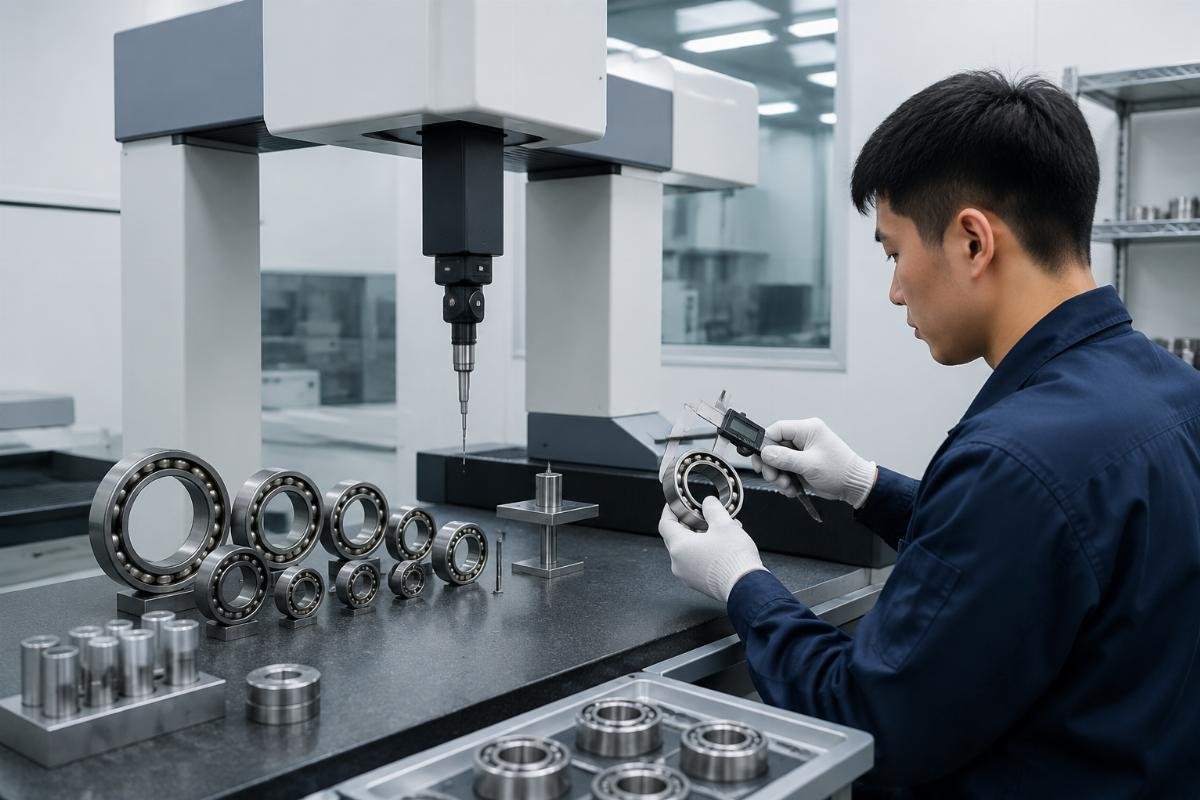
- Document Audit Protocol – Verify certification validity, cross-check batch numbers, and confirm material traceability
- Sample Testing Framework – Conduct dimensional inspection, material analysis, and performance testing per ISO 492 standards
- Reference Interview Questions – Prepare specific inquiries about on-time delivery, quality consistency, and problem resolution
- Factory Visit Checklist – Evaluate production equipment, quality control stations, and inventory management systems
- Pilot Order Structure – Design small initial order to test delivery, documentation, and product quality before full commitment
What Red Flags Should You Avoid When Sourcing Bearings from China?
Common red flags include inconsistent documentation, refusal to provide batch-specific data, and inability to explain technical specifications. Recognizing these warning signs early in the supplier selection process

Written by
zhaikevip@gmail.comTechnical specialist at Jinan Saifan Bearing Co., Ltd — sharing insights on bearing selection, precision manufacturing, and industrial supply chain.


Leave a Reply